
Wealth Preservation Tax Planning Lifestyle
Dubai vs Monaco: Where Wealthy Expats Actually Settle
In this article, we compare Dubai vs Monaco to see which is the best destination for wealthy expats.
First, we look at taxes in both countries before exploring other key factors, including lifestyle, location, real estate opportunities, and the immigration process.
We also look at some other alternative destinations which are popular with HNWIs, some of which are obvious, while others are still growing in popularity.
Dubai Vs Monaco – Overview
On paper, Dubai and Monaco are very similar.
Both have governments based on a form of constitutional monarchy and large expat communities which outnumber the locals.
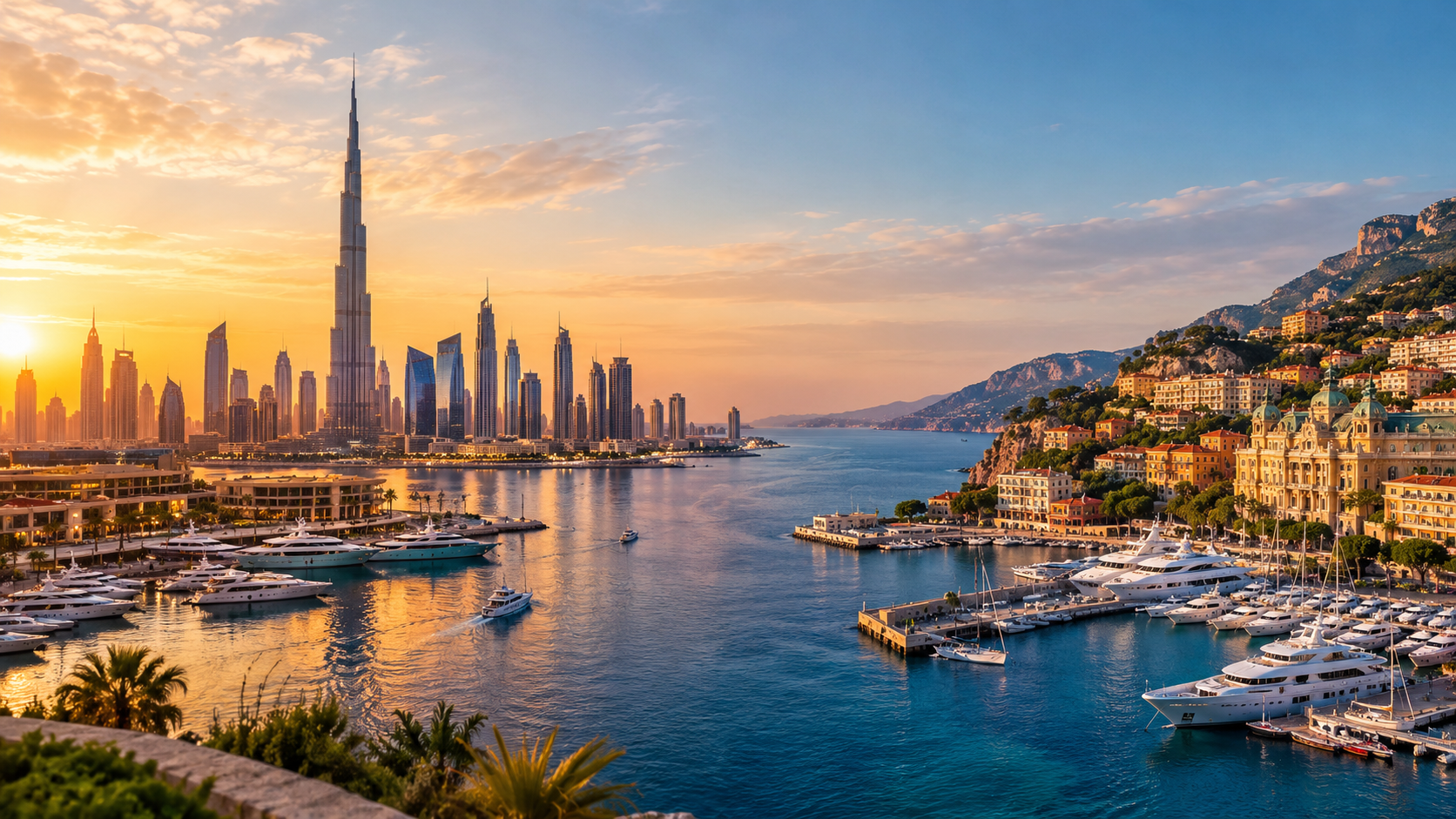
Both are popular wealth hubs with large marinas full of luxury yachts and iconic architecture.
Both destinations are known as much for their glamour as for their tax-free living, thanks to appearances in popular movie franchises (James Bond in Monaco, Mission Impossible in Dubai).
Yet, in practical terms, these two jurisdictions are poles apart.
Dubai – The Home of Hustle Culture:
Dubai is a wealthy city-state on the Persian Gulf, one of the seven emirates of the United Arab Emirates.
Since gaining independence from Britain in 1971, the oil-rich UAE has grown rapidly, with Dubai becoming especially popular with foreigners.
Today, an estimated 88/89% of Dubai's 4 million residents are foreigners, including many Westerners who came to the city in search of better opportunities.
Even now, in the aftermath of the 2026 Gulf crisis, the draw of Dubai is strong, which is why, while some expats have moved back west, others continue moving in the opposite direction, leaving Western countries to take advantage of Dubai's economic opportunities and zero income tax.
Monaco – Historic Exclusivity:
While Dubai is synonymous with new money and hustle culture, Monaco is very much about old money and tradition.
The ruling Grimaldi dynasty has endured for centuries, and, except for its annual Formula 1 Grand Prix, Monaco is not known for its fast pace.
With a total area of just two square kilometres, it's the world's second-smallest country (after Vatican City) with a population of just over 38,423 residents. Native Monegasques make up less than a quarter of that population, the rest of whom are foreigners.
Much of its workforce is also foreign, mainly French and Italian, who cross the border every day for work (unlike Dubai, where its workforce all resides in the city).
While Monaco's status as Europe's only tax-free jurisdiction certainly has its appeal, its limited space has a distorting effect on its real estate market, which is exacerbated further by local bureaucracy.
Dubai Vs Monaco – Taxes
Dubai and Monaco are both tax-free in theory, but not in practice.
The tax-free myth stems from the fact that both the UAE and Monaco do not charge personal income tax. They also have no capital gains, gift or inheritance taxes.
VAT and other duties still apply, however, and corporations are subject to corporate taxation.
Result: Draw – both offer comparative regimes with zero income and capital gains taxes.
Dubai Taxes – Global Realignment
For many years, Dubai operated without VAT and corporate income tax. In 2018, the UAE adopted a VAT rate of 5% as part of an agreement between the GCC countries and the IMF.
Then, in 2022, the UAE enacted a law that introduced a 9% corporate income tax on income over AED 375,000 ($102,000 approx.) to bring the country into alignment with OECD Pillar 2 guidelines.
Even before these changes, Dubai was technically not 100% tax free as there were still duties and import taxes and the Emirate still maintains these on goods entering the Dubai mainland.
You can gain exemptions from these, however, if your business qualifies for inclusion in one of Dubai's free zones , which also lets you enjoy exemptions from corporate tax if you meet the criteria of a qualifying free zone person and provided your revenue remains inside the free zone, and does not extend outward to the Dubai mainland.
Monaco Taxes – The French Connection
Monaco's story is quite different. Rather than being nudged towards alignment with global standards by the international community, the Principality was put under intense pressure to completely overhaul its tax system by the post-war French president Charles de Gaulle.
The result was a 1963 agreement with France whereby French nationals could no longer take advantage of Monaco's 0% income tax.
The agreement also established VAT and a corporate income tax in the Principality. The current VAT rate is 20%, while companies earning over 25% of their income from foreign sources are subject to a rate of 25%.
Dubai Vs Monaco – Lifestyle
In lifestyle terms, Dubai vs Monaco is a case of meritocracy versus aristocracy, or to put it another way, new money versus old money.
Dubai is larger, livelier and more modern, a place to work hard and play hard. There's always plenty to do and lots of space to do it in, and the nature of the city means there is always a regular influx of expats, meaning there are always new faces and new people to meet.
Monaco, by contrast, is smaller and far more static, there are fewer things to do since space is so limited, so you will invariably end up spending far more time in neighbouring countries like Italy and France.
Unlike Dubai, which is wealthy but affordable on the whole and accessible to all, Monaco is more expensive and far more select.
For years, it was the exclusive domain of elites and so-called high society, before later becoming synonymous with the "jet set", as Hollywood movie stars and other celebrities mingled with the old aristocracy.
This history, coupled with its motor racing heritage, explains why Monaco holds a certain fascination for tourists, though many HNWIs will find the country comparatively quaint, especially if they're used to more upbeat wealth hubs like Dubai or Singapore.
Monaco's Mediterranean climate is also a clear winner when compared with Dubai's desert heat, sprawling malls and always-on air conditioning.
Result: While Monaco offers a slower pace, superior climate and a central European location, however Dubai wins on pure scale and variety of activities available.
Dubai Vs Monaco – Location
Dubai is best known for its iconic skyline, featuring the world's tallest building, the Burj Khalifa.
Monaco is known for its old-world architecture and winding, seaside topography, both of which feature prominently in the country's annual Formula 1 Grand Prix.
While its tourist attractions are many, Dubai's primary function is as a major financial centre and trade hub, as well as being home to the world's busiest international airport.
As a result, Dubai offers everything you need in a completely self-contained environment with the added bonus of direct flights to pretty much every major destination in the world.
Monaco, by contrast, is the second smallest country on earth after the Vatican City and has the second highest population density after Macau.
Limited space means limited activities, which is why residents employ geoartbitrage strategies which allow them to take advantage of Monaco's tax benefits while enjoying a broader range of activities in France, Italy and beyond.
Result: Dubai wins because there is simply so much more to do and far more space to do it in.
Dubai Vs Monaco – Real Estate
Dubai's real estate market, which had been overheating for years, just got a hard reset.
The recent Gulf conflict certainly played its part, though trends showed a market correction would have likely occurred in 2026 regardless, albeit at a much slower pace.
While the number of foreign repatriations was not as dramatic as people expected, many foreign residents are still keen to sell up. This, in turn, is attracting speculators who are coming to Dubai in search of bargains.
Aside from residential property, commercial property, especially office space, remains in high demand, and this situation is unlikely to be remedied any time soon.
Overall, Dubai's real estate market has proven far more resilient than expected, while new developments mean that rental costs are also cooling, helping to make the city more affordable than before.
Monaco, by contrast, is home to the most expensive real estate on the planet, more than New York or Hong Kong, and, given the country's tiny size, this will likely never change.
Monaco's government also has protections in place to ensure its native-born citizens can continue to avail themselves of affordable housing and not get priced out of their own country.
As you can imagine, this means more bureaucracy, which means more paperwork and longer wait times, and all of this puts off investors.
There's also the matter of value; $1 million in Monaco would barely buy you a broom closet, whereas in the UAE, you could potentially buy a luxury apartment for around half that cost.
Better still, you could find a property at the $545,000 threshold and then apply for a ten-year golden visa.
Result: With far more value and variety in the property market, plus far more flexibility when it comes to investing, Dubai wins this round by a considerable margin.
Dubai Vs Monaco – Immigration
The UAE offers multiple visa types, including a one-year renewable digital nomad visa, which is particularly popular with young professionals and entrepreneurs looking for a taste of the Dubai lifestyle.
The country also boasts a five or ten-year renewable golden visa program, with an investor-friendly real estate option.
A ten-year golden visa can be obtained with a minimum property investment of $545,000 (plus fees), allowing you to take full advantage of the Dubai lifestyle with zero income tax or capital gains.
Monaco offers the same tax benefits, but, like its real estate market, the process is more restrictive and convoluted.
Before you can apply, you must either own or have a long-term lease on a Monacan property – easier said than done, given the limited number of properties available.
Second, you will need to prove to the authorities that you have sufficient funds to live in Monaco, which entails opening an account with a Monaco bank and making a minimum deposit of €500,000 before the process can begin in earnest.
It's worth pointing out, though, that for roughly the same cost as that deposit, you can purchase a Dubai property instead and obtain your ten-year renewable UAE golden visa.
As for citizenship, UAE citizenship is only granted to foreigners under extremely rare circumstances via citizenship by exception (unlikely to happen unless you can guarantee them an Olympic gold medal.)
In theory, Monegasque citizenship is possible, but it is rare, requires a minimum of 10 years of permanent residence and remains at the sole discretion of the prince.
Since the Principality doesn't recognise dual citizenship, you would therefore be required to renounce your current citizenship and forfeit any chance at attaining dual citizenship elsewhere, which is a major dealbreaker in our book.
Result: Dubai once again wins thanks to its popular visa programs and readily accessible real estate market.
Dubai Vs Monaco – Alternative Jurisdictions
When the UK cancelled its non-dom program in 2025, many wealthy individuals and families left the country.
Dubai and Monaco were two of the top destinations, though they were hardly the only ones.
Many founders, particularly young entrepreneurs, still find themselves drawn to Dubai and its lively, tax-free lifestyle.
They are just as likely to find the limited activities and sluggish pace of Monaco off-putting, though they may still consider it a worthy trade-off given Monaco's central European location.
The only alternative is to look at alternative low-tax options in the region, countries which offer specific reductions on income tax, rather than outright exemptions.
One such option is Switzerland, which is attractive to HNWIs for its central European location and overall stability. The other big draw is the special Swiss lump-sum tax regime, which is based on living costs, rather than income. (The only thing to be wary of is earning gainful income locally, as this will terminate the tax agreement and you will then be taxed at standard rates.)
Next, we have the flat tax countries, Italy and Greece, providing an exemption from foreign-sourced income (local-sourced income remains taxable at standard rates) in exchange for a fixed annual amount.
Italy's flat tax seems to be the more popular option, despite the fact that the government keeps raising the price. (It was €100,000, then it was €200,000, now it's €300,000.)
The cost of Greece's flat tax remains set at €100,000 but the caveat here is that you also need to make a €500,000 investment in the Greek economy. The good news, however, is that this includes the option to invest in real estate.
Both flat tax regimes have a time limit of 15 years, after which time regular rates apply.
Another popular European option is Malta's TRP/GRP program, which taxes foreign income you bring into Malta at a flat 15%. Leave it outside Malta and it isn't taxed there at all. Foreign capital gains stay untaxed either way. Any Malta-source income, meanwhile, is taxed at 35%.
Cyprus, meanwhile, offers a British-style non-dom type program with an exemption on foreign-sourced income for up to 17 years, plus no capital gains taxes except on domestic real estate.
Finally, as we head even further east towards the Caucasus, we arrive in Georgia, a business-friendly nation connecting Europe and Asia, which has grown popular with investors and digital nomads alike.
Georgia offers a true territorial tax system; all foreign-sourced income is exempt, while a 20% rate applies to local income only. It also offers a streamlined real estate path to obtain tax residency.
Dubai vs Monaco – Key Points
- Both the UAE and Monaco offer similar tax savings with zero income tax or capital gains.
- Dubai is a large city within the UAE, while Monaco is the world's second smallest country.
- Dubai has a thriving real estate market, Monaco's property market is the most expensive in the world.
- Dubai is more self-contained in terms of lifestyle and activities, Monaco residents tend to spend much of their time in neighbouring Italy and France.
- You can become a Dubai resident through a UAE golden visa, obtaining residency in Monaco is more difficult.
- The UAE grants citizenship only in exceptional circumstances. Though difficult, it is possible to obtain Monegasque citizenship, but Monaco does not allow dual citizenship.
Dubai Vs Monaco – Conclusion
Dubai vs Monaco is not really a fair fight, since, apart from having similar taxation, they are two vastly different jurisdictions.
Dubai is a large city-state that caters to a broad range of wealthy individuals, itself a part of a larger national wealth hub. It is new, modern and meritocratic, a place for talented and ambitious people to seek their fortunes.
Monaco is a tiny Principality synonymous with old money and prestige. As the world's second smallest country, it has limited space and even more limited scope, a niche jurisdiction for an elite clientele. Its property market is more exclusive, and its pace is much slower. (Unless it's the F1 weekend, obviously.)
In other words, Monaco is not a place to seek your fortune but rather a place to park it while you sip wine and savour the languid Riviera lifestyle.
If this sounds appealing – and to many it does – we can certainly understand why. Just as we can understand the draw of a European country with such a rich heritage spanning centuries, versus the contrived high-rise extravagance of Dubai.
At Millionaire Migrant, however, we're less concerned with vibes and aesthetics. Our main focus is on opportunity and value. Dubai may have had a bumpy ride of late to put it mildly, but its economy remains buoyant and lucrative investment opportunities are abundant.
Confused about taxes, residencies and competing jurisdictions? Get the clarity you need with Millionaire Migrant – your offshore consultant is just a quick phone call away.
Dubai Vs Monaco – FAQ
What Country is 100% Tax Free?
While countries like the UAE and Monaco have zero income tax, no country is 100% tax free. All countries charge taxes of some form or another for two reasons.
The first is internal and relates to treasuries; even the wealthiest countries still require steady streams of revenue, be that through import duties, VAT and so on. After all, even the most business-friendly governments still need reliable ways to fill their coffers.
The second factor is external, with mounting pressure to comply with global tax standards as determined by organisations like the OECD. Such concessions are often necessary to remove friction, facilitating trade and a more harmonious global financial system.